How Big is Russia Actually?
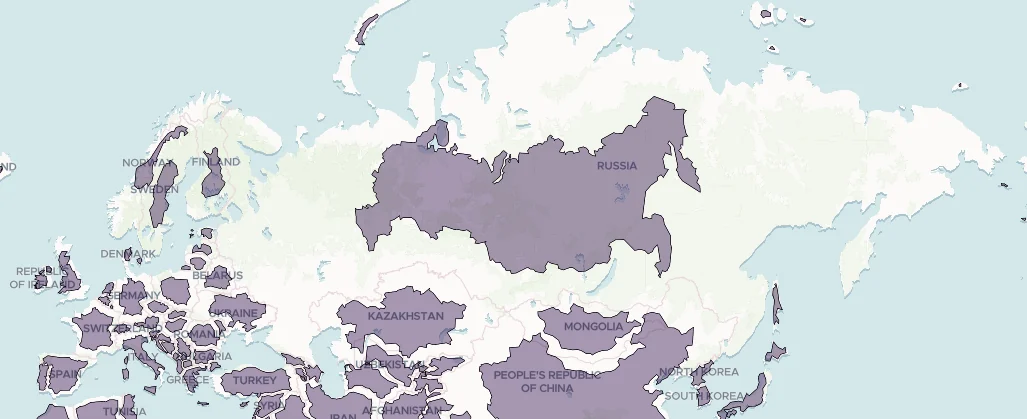
← All postsContemplating the size of Russia on any modern map can evoke a sense of inferiority. It sprawls across half the world like some gargantuan tick with a European head and an Asian body. In its guts, it could probably fit at least four Europes, suggests the map. And a trip across Europe is likely an order of magnitude shorter than one across Russia. This is further suggested by stories of exiles, banishments, the Trans-Siberian Railway, etc.
So, driven by curiosity, we decide to check. We draw a line from St. Petersburg to Lisbon and another, from St. Petersburg all the way to the eastern edge of the "empire." It's known that the lines don't account for the curvature of the Earth, but roughly speaking, it seems that the second journey would be about three times longer.
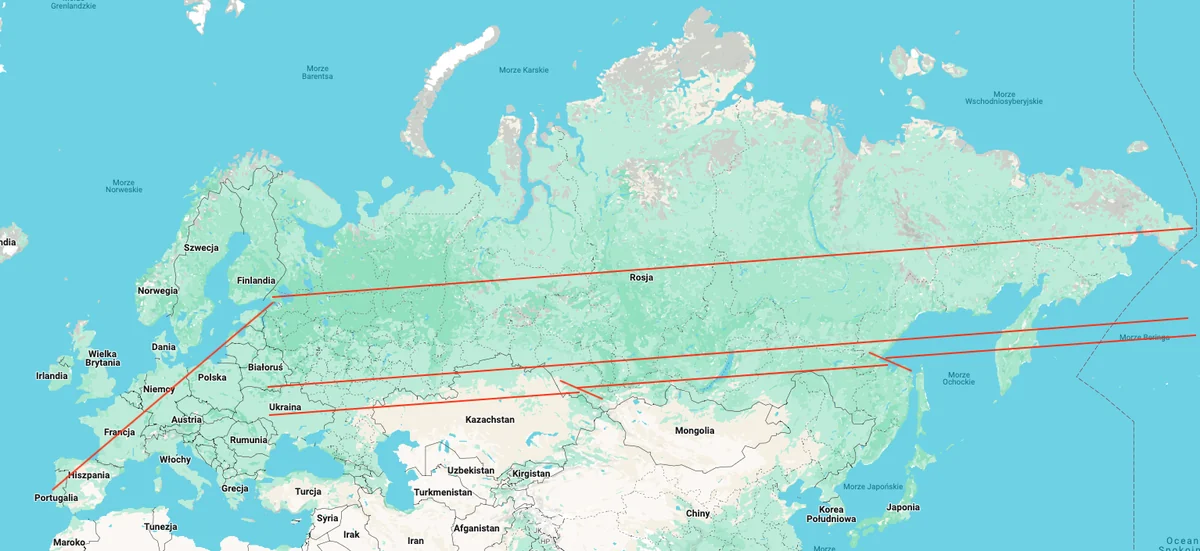
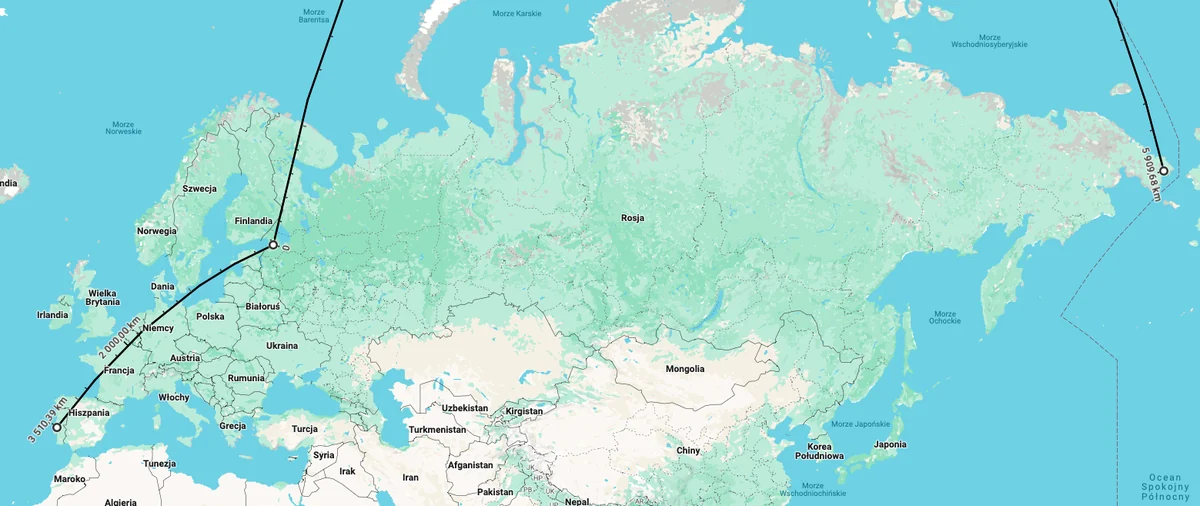
Let’s see how this plays out in numbers. We use a tool to measure distances on Google Maps, and it turns out the distance from St. Petersburg to Lisbon makes sense, at around 3500 km. The curvature marked on the map also seems reasonable. However, in the case of Russia, the curvature looks peculiar, and we expected a slightly larger distance. The distance turns out to be just under 6000 km, or about 1.7 times the first one. Not orders of magnitude, not three times as much, but less than twice the distance from St. Petersburg to Lisbon.
Let’s look at some other numbers. Europe without Russia covers about 6 million km², while Russia spans 17 million km², meaning Russia could fit fewer than three Europes. Looking at the map, we expected more. Where do all these discrepancies come from, disadvantageous for Russia’s territory? From the Mercator projection of 1569, a cartographic technique used to transfer the spherical shape of Earth onto a flat sheet. Such a transfer must lead to distortions or simplifications, and this specific one makes countries farther from the equator appear larger than they actually are. We can check the actual size of countries on one of the available maps, like https://truesizeofcountries.com/. So, it turns out the devil is not as terrifying as it’s made out to be.